
‘Star Trek: Strange New Worlds’ Season 4 Episode 10 Recap And Ending Explained: The Future Collides
Modern science fiction television rarely balances nostalgic reverence and audacious experimentation with the finesse seen across recent years of streaming. When the franchise returned to the classic format of episodic planetary voyages, it signaled a broader creative revival for Paramount+ and its starship crews. By grounding character journeys within self-contained weekly missions, the storytelling struck a rare chord with longtime enthusiasts.
The road leading to this turning point was paved with studio backing, as Variety confirmed when the prequel secured an early season four renewal alongside shifting strategies for companion series like ‘Star Trek: Lower Decks’. That vote of confidence enabled an ambitious season defined by wild creative gambits, from puppet adventures to courtroom dramas. As the fourth season concluded, its trajectory moved ever closer to established canon.
The Temporal Breach in ‘Tomorrow’s Enterprise’
The season four finale, titled ‘Tomorrow’s Enterprise’, directly tackles the franchise’s most formidable narrative hurdle: the inexorable march toward ‘Star Trek: The Original Series’. Directed by Chris Fisher and written by Henry Alonso Myers and Robbie Thompson, episode 10 finds Captain Christopher Pike steering into a hazardous anomaly. A severe temporal rupture near the Neutral Zone destabilizes space-time, threatening the fleet’s historical continuity.
The initial trouble emerges when communications officer Lieutenant Nyota Uhura intercepts anomalous phantom transmissions echoing across fractured subspace frequencies. Uhura experiences distressing sensory echoes that initially resemble neurological trauma caused by a sudden plasma power surge. However, the Enterprise bridge crew soon deduces that these bleeding-through distress calls are transmitting from a future incarnation of their own vessel.
Two Timelines and a Life-or-Death Dilemma
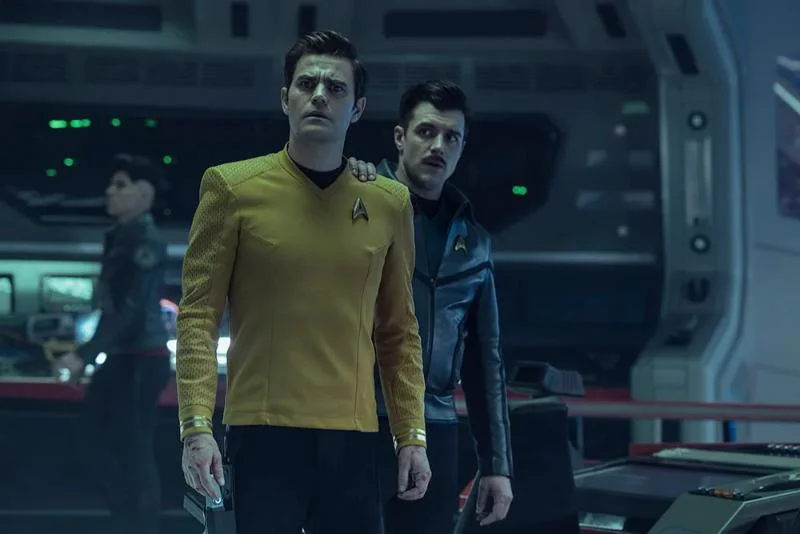
As the space-time rift widens, Pike’s bridge crew discovers that this future USS Enterprise is commanded by Captain James T. Kirk. The temporal bridge exposes a devastating reality occurring further along the timeline, where chief engineer Montgomery “Scotty” Scott is killed in a catastrophic engineering failure. Sparing the young Scotsman becomes a paramount imperative, as his premature loss would catastrophically warp the foundational history of Starfleet.
To rewrite this fatal outcome without fracturing the timeline, the story engineers a striking encounter between two incarnations of Uhura. Portrayed by Celia Rose Gooding, the present officer collaborates with her older counterpart, who sports the styling of the classic 1960s television run. Together, the two officers coordinate across the anomaly, recalibrating the warp shielding to avert the explosion and preserve Scotty’s life.
‘Tomorrow’s Enterprise’ Ending Explained: Accepting the Horizon
The resolution of the rift safely stabilizes the timeline, leaving Pike and his crew back in normal space with memories of what lies ahead. While the mission ends in technical victory, the ending carries profound emotional weight for the senior staff. Having witnessed Kirk commanding their starship, the crew must confront the sobering realization that Pike’s era at the helm is drawing toward its inescapable, tragic finish.
Rather than relying on memory wipes, the finale underscores the core philosophy of ‘Star Trek: Strange New Worlds’: the courage to press forward despite knowing what awaits. Pike’s ultimate fate remains unalterable, and this glimpse of tomorrow provides an emotional compass for the crew. The officers resolve to cherish their current fellowship, fully aware that the torch will soon pass to Kirk.
Paving the Runway for the Final Season
By directly showcasing this symbolic command transition, the season four finale deliberately sets the stage for the fifth and final season. Paramount+ has structured the upcoming conclusion as a focused six-episode arc, intentionally trading experimental genre excursions for a serialized narrative that bridges seamlessly into Kirk’s inaugural mission.
Co-showrunner Akiva Goldsman explained to Collider that the ultimate chapter required a more singular artistic discipline. “I would say they’re a suite. They’re a set of episodes,” Goldsman noted about the final season. “I think they are tonally more singular than is typical for us… Really, five is a goodbye. It is a six-episode goodbye. And it’s not solemn, but it is all the colors of goodbye.”
Ultimately, ‘Tomorrow’s Enterprise’ stands as one of the most poignant installments in modern science fiction television, deftly blending exhilarating time travel mechanics with rich thematic resonance. It honors the rich history of the franchise while giving its current cast an unforgettable launchpad into their upcoming farewell voyage across the stars.
What did you think of the temporal twists in ‘Tomorrow’s Enterprise’, and how do you feel about the series concluding with a serialized six-episode goodbye?
Have something to add? Let us know in the comments below!