What Is ‘East of Eden’ Based On? The History Behind the Netflix Epic
Adapting foundational American literature has always presented prestige television with one of its most intricate creative tightropes. Sprawling multi-generational chronicles demand a patient balance of sweeping period detail, expansive worldbuilding, and deeply personal emotional stakes. When streamers look to reinterpret classic mid-century prose, the goal often centers on finding modern resonance within narratives that helped define twentieth-century storytelling.
The contemporary television landscape has increasingly pivoted toward limited series formats to provide literary masterworks the space they historically lacked on the silver screen. Feature films often condense decades of generational turmoil into brisk two-hour runtimes, sacrificing vital character arcs in the process. By expanding these intricate texts into multi-part television events, filmmakers can finally dissect complex character dynamics that single movies had to overlook.
At the heart of this prestige push is ‘East of Eden’, a new seven-episode limited series based entirely on John Steinbeck’s celebrated 1952 magnum opus of the same name. Spearheaded by writer and executive producer Zoe Kazan, the production resurrects Steinbeck’s ambitious chronicle with an unprecedented family connection. Kazan is the granddaughter of Hollywood icon Elia Kazan, who directed the legendary 1955 cinematic adaptation starring James Dean.
Steinbeck’s Salinas Valley Epic and the Kazan Legacy
Published in 1952, Steinbeck considered ‘East of Eden’ his defining masterpiece, framing it as the story of his country and his family. Set in Northern California’s Salinas Valley between the Civil War and World War I, the narrative traces two intertwined dynasties: the Trasks and the Hamiltons. Operating as a grand biblical allegory, the novel reframes Genesis to explore free will, guilt, and sibling rivalry through the lens of Cain and Abel.
Steinbeck grounded the novel in his personal ancestry, drawing upon his upbringing in Salinas among local homesteaders and farmers. His depiction of the Hamilton clan drew directly from the life of his maternal grandfather, Samuel Hamilton, infusing an autobiographical intimacy into the drama. That familial tether gave his philosophical examination of human morality an enduring, lived-in resonance.
While Elia Kazan’s 1955 film earned four Academy Award nominations and cemented Dean’s star status, it adapted only the final fourth of Steinbeck’s sprawling literary tome. The theatrical release narrowed its focus to the tragic fraternal struggle between Cal and Aron Trask in the shadow of World War I. In contrast, Zoe Kazan’s seven-episode version explores the entire three-generational lineage, establishing the formative conflicts that shaped the family patriarchs decades prior.
Reinterpreting Cathy Ames and Assembling the Cast
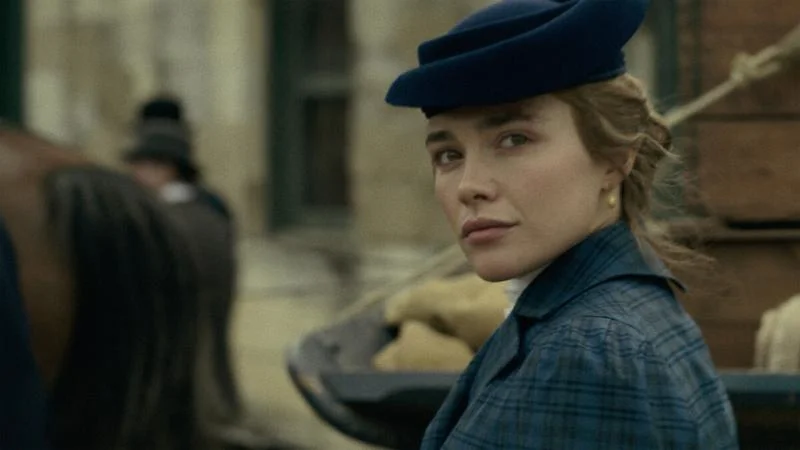
Central to this retelling is Cathy Ames, an infamous character Steinbeck famously described as possessing a malformed soul. Rather than presenting her merely as an irredeemable monster, the limited series approaches her psychology with greater nuance and tragic complexity. Oscar-nominated actress Florence Pugh leads the production as Cathy, taking on both the starring role and executive producer responsibilities.
Pugh emphasized her desire to humanize the character without excusing her actions, noting, “I really wanted to try and get underneath all of the decisions that she makes and not just do the easy cheap version of making her a villain,” in a conversation with The Atlantic. She explained that the creative team refused to treat Cathy as simply monstrous, choosing instead to interrogate what drove her choices across multiple generations.
Production gained momentum when Deadline reported that Mike Faist and Hoon Lee had joined the ensemble alongside Pugh and Christopher Abbott, who portrays Adam Trask. The cast also features veterans Tracy Letts as Cyrus Trask, Martha Plimpton as Faye, and Ciarán Hinds as Samuel Hamilton. Rising actors Joseph Zada and Joe Anders round out the ensemble as fraternal twins Cal and Aron, anchoring the generational conflict.
Directorial Vision and Frontier Storytelling
To capture the raw physical isolation of early twentieth-century California, the production traveled to the untouched landscapes of New Zealand for extensive principal photography. Australian filmmaker Garth Davis directed the first four episodes, establishing the visual tone of the pastoral frontier, while Laure de Clermont-Tonnerre helmed the final three chapters. Veteran screenwriter Jeb Stuart serves as co-showrunner alongside Kazan, lending seasoned dramatic pacing to the sprawling narrative.
By treating Steinbeck’s source material as an expansive canvas rather than a compressed melodramatic outline, the production aims to honor both literary tradition and modern character study. Slated to arrive on October 1, 2026, the series bridges decades of Hollywood history by returning to a classic American saga through a bold new creative lens.
Are you excited to see John Steinbeck’s literary classic return to the screen with Florence Pugh, and what are your expectations for the series—let us know your thoughts in the comments below!
Have something to add? Let us know in the comments below!