
What Is ‘Unabomber’ Based On? The Disturbing True Story Behind Netflix’s Thriller
True crime cinema has increasingly shifted its focus from straightforward police procedurals to complex character studies of psychological degradation. Streaming platforms have embraced this evolution, offering viewers prestige feature films that investigate the dark intersections of institutional authority, human fragility, and violent radicalization. Rather than simply replaying notorious crimes for shock value, modern filmmakers are uncovering the obscure historical traumas that quietly set catastrophic events into motion.
Netflix continues this nuanced approach with ‘Unabomber’, an intense psychological thriller directed by Janus Metz from a script by Sam Chalsen and Nelson Greaves. Starring Russell Crowe, Jacob Tremblay, and Shailene Woodley, the 97-minute production sidesteps traditional true-crime formulas by constructing a fractured, dual-timeline narrative. That inventive structure has ignited curiosity among audiences eager to learn how much of the film’s psychological premise is grounded in verified American history.
At its historical core, ‘Unabomber’ is based on the actual life and radicalization of domestic terrorist Theodore “Ted” Kaczynski, focusing specifically on his formative years as an adolescent mathematics prodigy at Harvard University. Long before he launched an untraceable 17-year bombing spree that killed three people and wounded 23 others between 1978 and 1995, Kaczynski was an intellectually gifted 16-year-old student who entered the Ivy League institution in 1958. The film explores how an extraordinarily bright young scholar gradually devolved into a paranoid recluse living in the Montana wilderness.
The Dark Reality of the Harvard Psychological Experiments
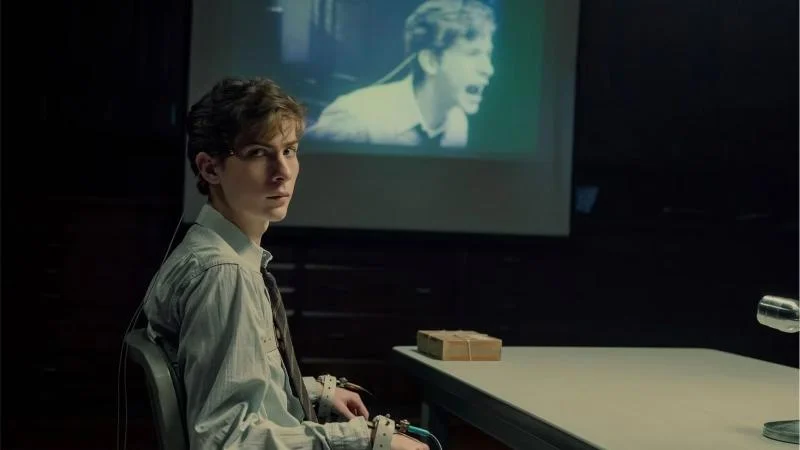
The most shocking dimension of ‘Unabomber’ centers on Kaczynski’s real-life participation in a series of emotionally grueling psychological experiments conducted by Harvard professor Dr. Henry Murray. During his undergraduate studies between 1959 and 1962, Kaczynski volunteered for what he believed was an academic debate concerning personal philosophies and core human values. Instead, Murray—whose work was backed by Central Intelligence Agency funding during the Project MKUltra era—subjected young students to more than 200 hours of verbal humiliation, stress monitoring, and systematic ego destruction.
These harrowing sessions inflicted deep psychological scars on the vulnerable teenager, cementing an intense skepticism of social systems that echoed throughout his adult writings. As reported by E! News, Tremblay admitted, “I didn’t even know he went to Harvard until I read the script; I think most people don’t. But he was a mathematical genius when he was 16. It’s quite fascinating, actually.” That obscure historical detail provides the essential psychological groundwork for understanding how academic trauma catalyzed Kaczynski’s descent into violence.
Blending Historical Fact With Fictionalized Federal Pursuit
To contrast Kaczynski’s early intellectual collapse with the federal manhunt that eventually ended his terror campaign, ‘Unabomber’ introduces FBI Agent Joanne Miller, portrayed by Shailene Woodley. While the UNABOM Task Force was an enormous, real-world multi-agency operation, Miller herself is a dramatized composite figure crafted to anchor the investigative timeline. Her onscreen investigation uncovers the long-buried CIA-linked experiments, creating a compelling thematic bridge between Murray’s academic laboratory in Cambridge and the federal raid on Kaczynski’s cabin in 1996.
Taking on such an infamous historical figure represented a drastic creative departure for Tremblay, who rose to prominence as a child actor in ‘Room’. Discussing the intense preparation required to inhabit the troubled mind of the young bomber in an interview with Entertainment Tonight, Tremblay explained that “it was very different from all the other movies I’ve done,” emphasizing his desire to portray Kaczynski with authentic emotional dimension rather than caricature. That grounded performance allows the film to emphasize the tragic human consequences of unchecked psychological experimentation.
Russell Crowe brings a terrifying intellectual charisma to Murray, capturing the chilling arrogance of an era when ethical boundaries in psychological research were routinely shattered. The dramatic friction between Crowe’s manipulative professor and Tremblay’s isolated student underscores the core question posed by the screenwriters: how much did institutional experimentation cultivate an American monster? While the filmmakers never excuse Kaczynski’s horrific acts of terrorism, they refuse to ignore the toxic academic environment that fractured his fragile mental state.
A Fresh Perspective on an Infamous True Crime Case
Unlike earlier projects such as ‘Manhunt: Unabomber’ or ‘Ted K’, which concentrated heavily on linguistic forensics and isolated survivalism, ‘Unabomber’ prioritizes the psychological roots of radicalization. By contrasting the cold corridors of Harvard with the frantic federal manhunt decades later, Janus Metz crafts a gripping examination of trauma, ego, and technological alienation. In doing so, the film transforms a familiar true-crime tragedy into a sobering cautionary tale about the ethical responsibilities of scientific ambition.
Do you think Kaczynski’s experiences at Harvard played a major role in his radicalization, or was his descent into violence inevitable?
Have something to add? Let us know in the comments below!