
Netflix’s ‘Unabomber’ Ending Explained: The Truth Behind Joanne’s Tears And Ted’s Radicalization
True-crime dramas on streaming services continue to captivate audiences, and the legacy of Ted Kaczynski remains one of the darkest chapters in American history. Netflix’s ‘Unabomber’ revisits the notorious domestic terrorist whose lethal bombing campaign paralyzed the country for nearly two decades. The project examines the web of ideological obsession and federal law enforcement pursuit that eventually brought down the elusive fugitive.
Directed by Janus Metz, the psychological thriller moves beyond standard procedural tropes by exploring the roots of radicalization. Instead of focusing solely on the federal investigation, the film constructs two parallel timelines dividing the narrative between the 1960s and 1990s. This deliberate dual structure invites viewers to analyze the formative experiences that transformed an awkward prodigy into a detached killer.
The thematic climax of the film emerges when these two timelines collide, revealing that Kaczynski’s violent crusade was catalyzed by institutional trauma rather than pure ideological madness. Young Ted’s gradual dehumanization under state-sponsored university psychological experiments mirrors the hollow, emotionally devastating conclusion of the 1996 federal manhunt.
The Dual Timelines And The Harvard Psychological Experiments
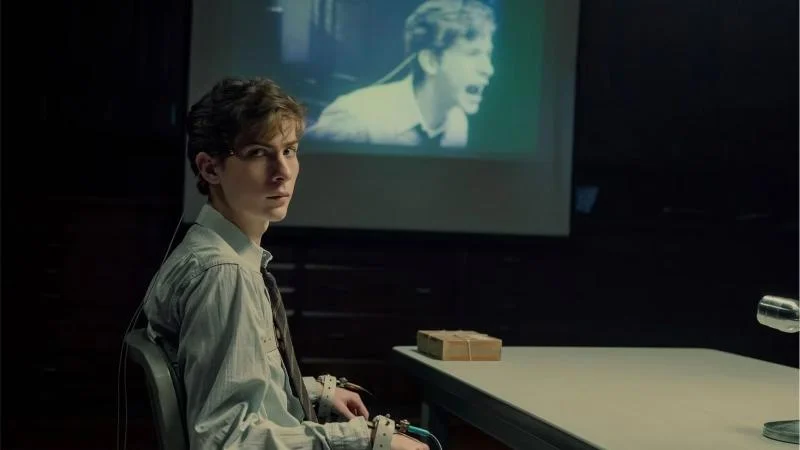
During the 1960s timeline, a 16-year-old math prodigy named Ted Kaczynski (Jacob Tremblay) enters Harvard University completely unprepared for the emotional isolation awaiting him. Desperate for intellectual validation, he volunteers for a study conducted by psychologist Henry Murray (Russell Crowe). Unbeknownst to the young student, the sessions are part of a brutal interrogation experiment designed to shatter personal convictions.
Tremblay channeled his own background in show business to capture the profound alienation of an adolescent navigating an environment dominated entirely by adults. “What I found, and what I really held on to, was the idea of being the youngest person in the room,” Tremblay revealed in an interview with CBC News. That perpetual sensation of awkwardness and social displacement ultimately formed the bedrock of his character’s psychological unraveling.
Across three years of testing, Murray subjects young Ted to relentless verbal abuse, filming his humiliated reactions and forcing him to watch the footage. When Kaczynski discovers that his private writings were merely exploited as weaponized data, his faith in humanity permanently fractures. The trauma instills a toxic belief that people are cold instruments within an oppressive technological machine.
The Montana Cabin Raid And Bureaucratic Breakthrough
In the 1990s timeline, fictional FBI investigator Joanne Miller (Shailene Woodley) spends years locked in a grueling search for the bomber. The breakthrough occurs when Kaczynski forces the publication of his 35,000-word manifesto in major newspapers. Recognizing the distinctive vocabulary, Ted’s brother David and sister-in-law Linda contact federal authorities to provide crucial familial evidence.
Metz rhythmically crosscuts between the federal raid on Kaczynski’s remote cabin in Lincoln, Montana, and young Ted’s final confrontation with Murray at Harvard. While young Ted leaves the university adopting the cold detachment that broke him, the older Kaczynski is arrested in his woodland sanctuary. The visual parallel highlights that while law enforcement captured the killer, the true tragedy was sealed decades earlier.
Why Joanne Miller Weeps At The Conclusion
The film’s most striking emotional note arrives not with Kaczynski’s capture, but in the quiet aftermath at FBI headquarters. While Miller’s colleagues uncork champagne and celebrate closing the longest investigation in bureau history, she stands alone in a hallway and weeps. Her profound grief directly subverts the triumphant tone typically celebrated in mainstream true-crime procedurals.
Miller’s tears signify the harrowing psychological toll that an obsessive pursuit inflicts upon those charged with upholding justice. Having witnessed the devastation of Kaczynski’s attacks, she realizes that apprehending the perpetrator cannot resurrect the three lives lost or heal the 23 people permanently scarred. The victory feels completely hollow because catching a monster demanded a devastating piece of her own humanity.
Russell Crowe explained that the project intentionally leaves viewers with lingering questions about institutional complicity and psychological vulnerability rather than neat closure. “It’s one of those pieces where you know it’s not necessarily going to solve everything for you, but it may well get you heading to your phone and opening up your Safari search,” Crowe stated in an interview with Entertainment Tonight.
The Haunting Final Message Behind ‘Unabomber’
By refusing to separate Kaczynski’s horrifying crimes from the academic abuse that shaped him, ‘Unabomber’ presents a sobering portrait of cause and effect. The film does not excuse his heinous acts, but it forces audiences to recognize how unchecked psychological cruelty can warp a vulnerable mind. In the end, society spent millions hunting the very monster its own institutions forged.
Share your thoughts on the ending of ‘Unabomber’ and whether Joanne Miller’s emotional breakdown resonated with you in the comments below!
Have something to add? Let us know in the comments below!